

Biodigester: between well-being in rural areas and vector for mitigating global warming

A biodigester installed in Boffa © Ibrahima Sory BAH / UniverScienceGN
The biodigester is a device which makes it possible to obtain biogas by transforming organic waste or human or animal excrement through anaerobic fermentation, that is to say without oxygen. It helps reduce pressure on forest resources and ensure the well-being of rural communities. In Guinea, as in other countries in the sub-region, this technology constitutes an important tool for mitigating the effects of global warming.
The biodigester has very beneficial socio-economic and ecological advantages, it provides an affordable and accessible source of energy. It thus improves the living conditions of rural populations, in particular women and children, it contributes to improving soil fertility and increases agricultural yields thanks to its organic fertilizer, obtained in the form of effluent.
Obtaining biogas
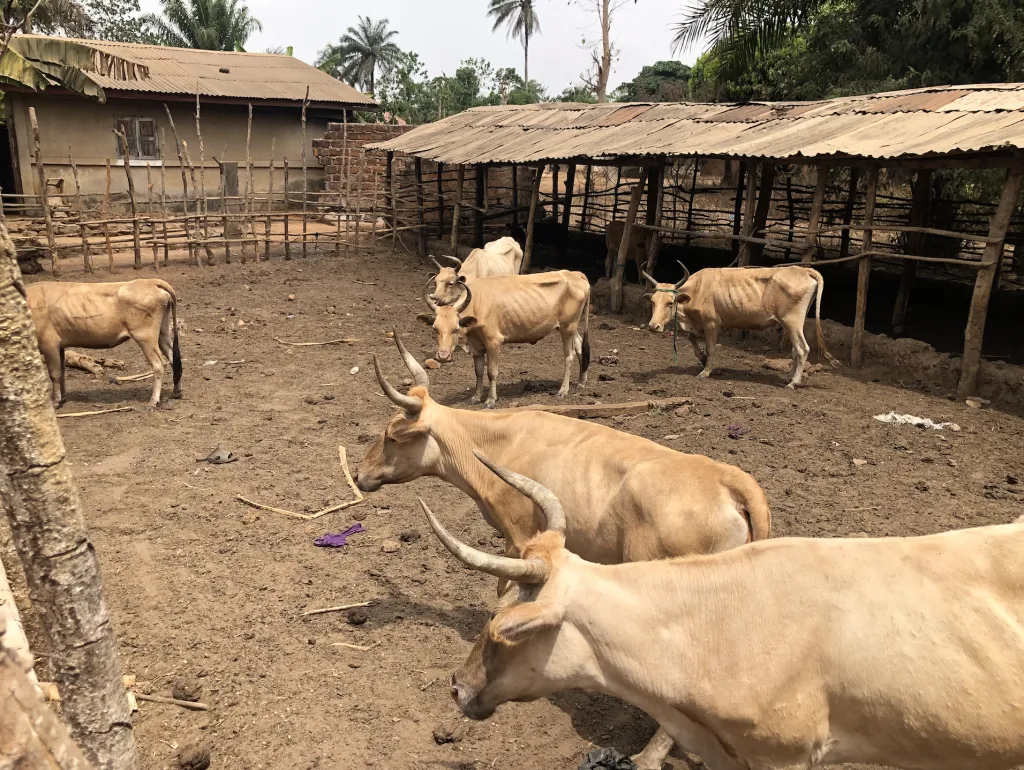
The process involves mixing water with cow dung and pouring this mixture into the inlet basin of the biodigester. Then, the mixture goes into the dome where it undergoes anaerobic fermentation, and then the biogas produced exits through a plumbing system to supply the kitchen and the lamp with lighting.. « The biogas produced by this technology is composed of methane (55 to 85%), carbon dioxide (25 to 45%), nitrogen, oxygen, hydrogen sulphide and water. explains Elhadj Mamadou Sow, Manager of biodigester technology at the national agency for the promotion of biodigester technology. To have a biodigester, you must have livestock of eight head of cow on average. Its implementation therefore quickly found its way given that agriculture and livestock represent the main activities in Guinea, potentially in rural areas.
A potential, a mitigation tool in Guinea
The option of biodigester technology is important as a tool for mitigating the impacts of climate change.“ Because Guinea has the potential of 800,000 biodigesters evaluated throughout the country,” according to the agency promoting biodigester technology in Guinea. Created in January 2021 following the end of the biogas project, the National Agency for the Promotion and Technology of the Biodigester has the mission of promoting biodigester technology in the country in order to consolidate the results obtained through the biogas project. This project financed by the Global Environment Fund (GEF) executed by the UNDP under the supervision of the Ministry of the Environment, Water and Forests at the time allowed the construction of 1600 biodigesters distributed in 28 out of 33 prefectures.
Advantage of the biodigester
The effluents obtained in this process are very rich in compost to make the soils very fertile and increase agricultural yields and replace chemical fertilizers.
In addition to the socio-economic advantages that the biodigester offers, that is to say, promoting the improvement of the living conditions of people, particularly women and children, by providing them with lighting, it allows children to study at night and during the day by allocating the time spent searching for firewood to other more beneficial activities such as studies. This technology has also enabled the education of young girls in rural areas and also by reducing their vulnerability. Biodigester technology in rural areas has also made it possible to considerably reduce the risks of insecurity and diseases linked to the use of firewood or charcoal, particularly among women and children.
Successful experiences
The project had installed mainly three types of biodigester, the most recurring is the fixed dome biodigester also called domestic with a capacity of 6m3. « It needs a daily ratio of 60 kg of organic matter (cow dung or pig droppings) to produce 5 m3 of gas per day. Sufficient capacity to power a kitchen containing two stoves for 4 to 6 hours and a biogas lamp for 5 to 6 hours. It also produces 220 liters of natural compost,” explains Elhadj Mamadou Sow, Manager of biodigester technology at the national agency for the promotion of biodigester technology. According to him, this type of biodigester preserves 4.5 tonnes of firewood equivalent to 0.3 hectares per year.
The beneficiaries welcome it
This young lady we met in Kindia has been using the biodigester for some time now, and her satisfaction is immense. “Before, we went into the bush even when we were home to look for dead wood to cook with. We are exposed to bites from venomous snakes or attacks from ferocious animals. With firewood, we are also exposed to the fiery heat of the fire which can sometimes lead to illness. Fortunately for us, we benefited from this biodigester which saves us from all these problems. We use cow dung which allows us to cook whenever necessary. rejoices Mamata Sylla, user of a domestic biodigester in the locality of Gbereakhorie, located 13 km from the town center of Kindia.
Naby Sylla, an octogenarian sitting in his chair in front of his house, has been using the domestic biodigester for several years. He proudly tells how using this technology has improved his well-being. “The advantage of the biodigester is favorable, we no longer go looking for firewood. The environment is well protected, the biodigester replaces charcoal and firewood, with it you can cook any sauce. welcomes Naby Sylla.
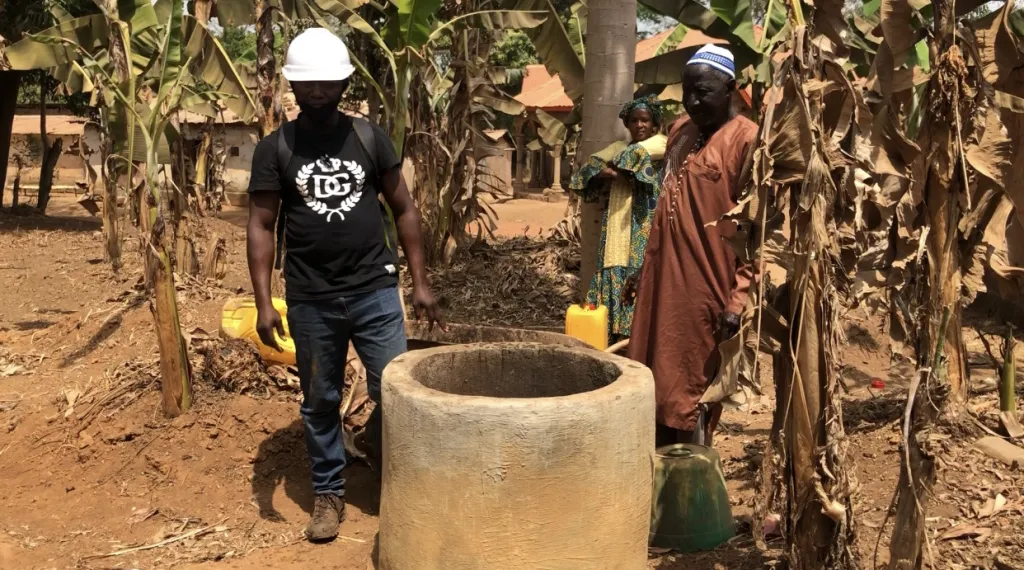
Having a banana plantation, he has noticed a clear improvement in his yield since he started using the biodigester. For him: « the fertilizer from his biodigester is not comparable to the chemical one he used before.” Thanks to the experience of Burkina Faso, a member country of the Alliance for the Biodigester in West and Central Africa, just like Guinea, the octogenarian manages to use his fertilizer rationally, which has earned him a good result today.
“With the effluent, we water the banana plants in a 2 liter bowl after we add soil. It is more profitable than other fertilizers. Conservation is also better compared to other fertilizers. The banana can ripen and remain for a week without rotting, a bunch of bananas can yield up to 30 kg. he explains with a satisfied air. According to him, his banana plantation had served as a training environment, «When the Burkinabés came, they called all the people in the region here, we spent 10 days here with the Burkinabés", he remembers.
On the other side, in the heart of the Boffa prefecture, 135 km from the capital Conakry, a group called the Union for the Renaissance of Agro-Pastoral in Koukouboui is also seeing a notable growth in its agricultural yields, a reduction in its diesel expenses and its carbon footprint thanks to its floating dome biodigester, also called semi-industrial.
Operating in livestock breeding, agriculture and palm oil extraction, the group had no difficulty in operating its biodigester. Because when it was introduced, it had 75 head of cows and a water borehole, enough to operate a large biodigester.
This floating dome biodigester with a capacity of 30 m3 that it has is quite efficient. “It produces 8 m3 of gas per day with a daily ratio of 200 kg of organic matter and 200 liters of water, it is connected directly to a generator, which completely reduces the generator's consumption of diesel,” explains Elhadj Mamadou Sow, Manager of biodigester technology at the national agency for the promotion of biodigester technology.
Through this connection, the generator only consumes one liter of diesel per day and it also supplies electricity to two houses and a palm oil extraction unit, “we use biogas for oil extraction, this has allowed us to reduce diesel expenses by almost 70% and it is beneficial for us”, AffirmsAbdoul Rahim Bah, member of the URAK group, beneficiary of the semi-industrial biodigester in Koukouboui.
The use of the biodigester has changed their daily lives, it has allowed the group to save money and increase their agricultural yield, despite difficulties encountered at the beginning due to lack of knowledge regarding the use of the effluent, “In terms of market gardening, we have overdosed the plants through ignorance. It was Madame Sylvie from Burkina who once explained to me how to use the effluent. he remembers.
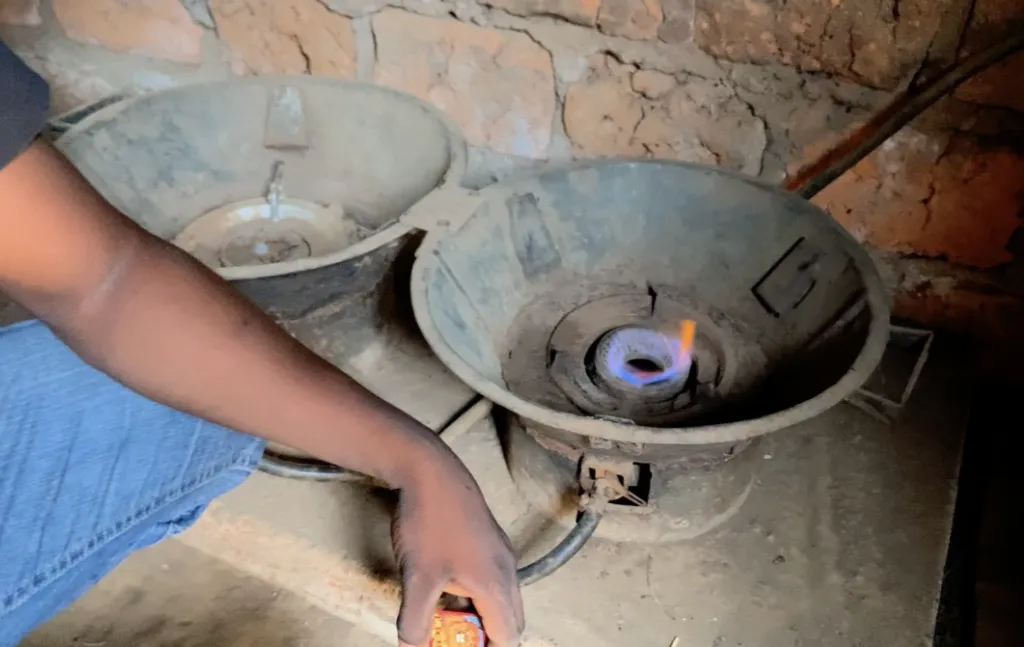
Gas stoves powered by the biodigester
Today he is delighted that the plants are all green during this dry season. “The Biodigester is good, it helps reduce excessive wood cutting and provides lighting,” he argues, smiling. In terms of environmental impact, their carbon footprint is significantly reduced to date, he said.
Challenges and Perspectives!
However, although the use of the biodigester has advantages for the environment and the well-being of communities, its acquisition requires a certain number of criteria which make its access difficult. It is also necessary to have on average 8 cow heads to have one. With the national agency for the promotion of biodigester technology, the cost varies between 9 to 10 million Guinean francs depending on the region. Livestock transhumance also encourages the abandonment of technology. “There have been customers who abandoned their biodigester because they moved their livestock,” says Elhadj Mamadou Sow, Technology Officer at the biodigester technology promotion agency.
The use of biodigester technology is very promising in preserving the environment. It helps curb pressure on forest resources. A biodigester that operates regularly makes it possible to preserve 0.28 hectares of forest per year and also makes it possible to capture 6.02 tonnes of carbon equivalent according to Dr Mamadou Saliou Boiro, director of the national agency for the promotion of biodigester technology.
Its promotion in the country is necessary because nowadays in Guinea, more than 80% of the main sources of energy supply come from biomass. Between 2018 and 2019 the results showed 52.1% wood and 46.3% charcoal as the main fuel used for cooking according to the national statistics institute in its 2022 statistical yearbook. These statistics thus demonstrate the extent of deforestation in the country, promoting climate change with disastrous consequences for the environment.
Fanta Barry and Ibrahima Sory Bah
This report is produced as part of the Terra Africa Project led by CFI Media.
Read also
 EpidemicScience
Mosquito virus in Guinea: study reveals discreet circulation in eight regions
A survey carried out in eight regions of the country reveals widespread, but discreet, circulation of viruses transmitted by insects. Zika…
 NICTFactuSciences
TikTok permanently closed in Guinea: the false press release that made the rounds on social networks
A false press release announcing the permanent closure of TikTok in Guinea has been circulating on social networks since July 28, 2026. Relayed…
 HealthScience
Dengue fever, yellow fever, West Nile virus: a Guinean study reveals silent circulation throughout the country
A team of Guinean researchers has just published, in the journal Tropical Medicine and Health, the results of a vast survey carried out in…
Leave a Reply