

At UGANC, 206 graduates called to transform their research into solutions for Guinea
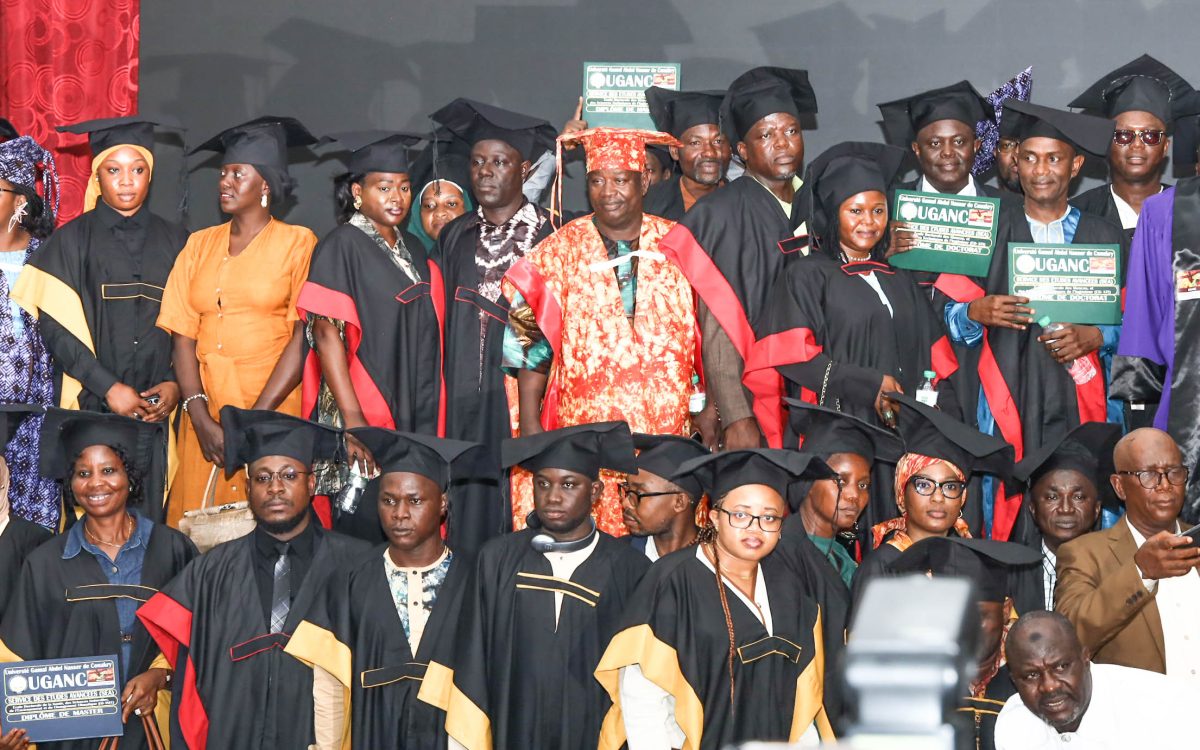
Long shot at the UGANC graduation ceremony © Ibrahima Sory Moudias
The Gamal Abdel Nasser University of Conakry (UGANC) celebrated, this Saturday, September 26, 2026, the awarding of Master's and Doctorate degrees to 206 recipients. A ceremony marked by recognition, scientific research and, above all, the responsibility to put the knowledge produced at the service of Guinean society.
There was pride, emotion and, behind the smiles, the weight of a new responsibility. This Saturday, the Gamal Abdel Nasser University of Conakry honored 206 graduates, including 138 Master’s degree holders and 68 new doctors in several specialties including: public health, microbiology, medical biology, mathematics, computer science, environment.
For Professor Alpha Kabinet Keita, rector of UGANC, this ceremony could not be reduced to a simple graduation ceremony. Speaking in front of the recipients, teachers, families and representatives of institutions, he first invited the audience to observe a minute of silence in memory of the teachers and masters who have passed away in recent months. “ Today is a day to pay tribute “, he declared, before saluting the memory of those who contributed to transmitting knowledge and building the university.
Several years of training and research
The ceremony comes three years after the launch of these annual graduation events. But, according to the rector, this year’s has a particular significance. Behind the announced figures lie, according to him, “ years of fieldwork, benches, calculations, nights of writing », often carried out with modest means. A reality which particularly concerns a large part of the recipients, already teaching-researchers or active researchers.
The latter had to carry out their scientific work while continuing to carry out their courses, their supervision and their professional and personal responsibilities. “ The credit goes to you first », Underlined Professor Alpha Kabinet Keita, while paying tribute to the supervisors, thesis directors, members of the juries and the families who accompanied the graduates throughout their journey.
Beyond the diploma, the rector recalled what training through research really represents: learning to ask a question, construct a method, produce reliable data and submit your results to the judgment of peers. “ A master's degree, a doctorate, beyond the concept, it is not simply a certificate of attendance “, he insisted.
Research focused on the realities of the country
Public health, microbiology, medical biology, environment, energy, oceanography, chemistry, natural products, mathematics, computer science, civil engineering and even telecommunications: the work presented by the new graduates covers areas directly linked to the needs of Guinea.
For the rector, this diversity shows that university research should not remain confined to lecture halls and laboratories. The dissertations and theses produced carry, according to him, results and recommendations which can contribute to treating the population, protecting the environment, managing natural resources, producing energy or even developing infrastructure.
This is why he launched a clear appeal to public institutions, communities, businesses and partners: bring scientific work off the shelves to give it concrete use. « A country that trains researchers without using them, without using their results, pays twice for their training “, he warned.
A message echoed by the representative of the Ministry of Higher Education, Dr Mory Sidimé, responsible for planning within the department. According to him, the ceremony concretely reflects the efforts undertaken as part of the training of trainers program, particularly through the objective of training 5,000 Masters and 1,000 doctors.
He believes that the research carried out by the recipients must now contribute to solving the problems facing Guinean society. “ These problems are in our society », He noted, emphasizing that the solutions resulting from this research are designed based on realities on the ground. For the representative of the ministry, dissertations and theses constitute not only a contribution to the scientific community, but also a potential source of decision support for public officials.
“A big responsibility” for new graduates
Among the voices heard during the ceremony, that of Dr. Mariama Camara, teacher-researcher in the chemistry department of UGANC and representative of the recipients, particularly reflects this state of mind.
For her, obtaining the diploma is certainly a moment of “ joy » and “ pride ”, but this pride is immediately accompanied by a responsibility: that of continuing to produce, transmit and promote knowledge. His own research focuses on the characterization of Boffa bauxites for the production of alumina by the Bayer process.
Through this work, the researcher measures the responsibility that accompanies the investment made by the nation in the training of its executives. “ This is what the nation has invested in us. It is our duty to make this investment bear fruit for the benefit of the common good. “, she said.
One sentence sums up the spirit of this ceremony: the diploma does not constitute the culmination of the scientific journey, but an additional step in the service of knowledge and development.
52 women out of 206 graduates: a challenge that remains
If the ceremony is a moment of satisfaction, it is also an opportunity to look at the challenges that remain. Of the 206 graduates, only 52 are women, or about a quarter of the recipients.
For Professor Alpha Kabinet Keita, this situation calls for continued efforts towards better representation of women in advanced training and scientific research. The rector also insisted on the need to guarantee stable and predictable funding for laboratories, equipment, scholarships, scientific mobility and publication of work. Because, according to him, investing in national research also means strengthening the country's capacity to produce its own answers rather than systematically depending on solutions designed elsewhere.
A new stage begins
In the different interventions, the same message ultimately emerged: the diploma should not be an end in itself. The new graduates, the rector asked to remain curious, rigorous and honest with the data produced, to continue to publish, to share their results and above all to transmit them in turn.
Training other researchers, sharing knowledge and keeping scientific curiosity alive: for him, it is also a way of remaining faithful to those who taught before them.
For Professor Aboubacar Oumar Bangoura, director of the advanced studies department at Gamal Abdel Nasser University in Conakry, new graduates from UGANC are now called upon to take a new step: transforming the knowledge acquired and the results obtained into concrete contributions to society.
Read also
 FactuSciencesEducation
Guinea: no, the government is not offering 960,000 computers to students, the announcement is false
A message circulating widely on WhatsApp claims that Guinea will distribute more than 960,000 free laptops to its…
 UncategorizedEducationFactuSciences
No, this video of Minister Bintou Keïta promoting a guide for high school graduates is not authentic
A video showing the Minister of National Education, Bintou Keïta, presenting a guide intended to prepare high school graduates for university has been circulating for...
 Education
Science, innovation, development: UGANC and CSIG open its 2026 scientific days
The Gamal Abdel Nasser University of Conakry (UGANC), in collaboration with the City of Sciences and Innovation of Guinea, launched its…