

The brilliant baccalaureate results contrast with the massive failures in the FSTS entrance exam. Crossed perspectives of Professor Touré and Professor Tounkara

Professor Tounkara on the left, Professor Touré on the right © UniverSciences
Resolving the thorny problem of mass enrollment within the faculty of medicine, pharmacy and odonto-stomatology of the Gamal Abdel Nasser University of Conakry (UGANC), now the Faculty of Health Sciences and Techniques (FSTS), has long been a major challenge. To remedy this, and boost the training of quality human resources in health in a sustainable and structural manner, a diagnostic study was carried out in 2017.
Prominent among the recommendations of this study was the regulation of admission to medical studies through a competition strictly governed by principles of transparency and fairness. This competition reserved exclusively for winners of the baccalaureate with honors in the experimental sciences and mathematics series aims to recruit the most brilliant students in the Republic. The implementation of this strategy, which began in 2018, faces a major difficulty, that of the discrepancy between the baccalaureate results and those of the FSTS competition. This discrepancy becomes acute following the results of the last recruitment competition, thus raising questions, reflections and possible solutions. Through these few lines we question ourselves.
Indeed, the students who brilliantly passed their baccalaureate this year, and selected for the competition on the basis of their distinction, failed massively. Out of more than 600 candidates, only 24 were admitted, a failure rate of more than 95%. We must hope that the results from other competitions such as access to preparatory classes for the grandes écoles will be better.
This massive failure represents the visible part of an iceberg whose contours and dimensions must quickly be identified by the three departments in charge of education, but also teachers and parents. Indeed our champions do not seem to be champions. How else can we explain such a discrepancy between two evaluations supposed to evaluate the same students with tests taken exclusively from their high school teaching program, corrected by their teachers?
Baccalaureate graduates who have obtained a distinction are assumed to have a solid mastery of the subjects taught in high school. Their success in the baccalaureate, considered a key indicator of their academic preparation, should logically allow them to succeed in a competition based on the same program and organized only a few weeks after the publication of the Baccalaureate results. However, the results of this competition tell a different story. They raise profound questions about the quality of the Guinean education system. If the subjects of the competition are well aligned with the high school program, why do these students, who excelled in the Baccalaureate, fail so widely in this competition? This could indicate that teaching and assessment methods in high school are not effectively preparing students for more competitive exams. Other factors, such as the transition from secondary to higher education, could also play a disruptive role.
While it is undeniable that the literacy rate of children has gradually increased over the decades in our country, it is clear that this increase seems to have been accompanied by a deterioration in the quality of education. Since the structural adjustment policies proposed by the World Bank in the early 1980s, the Guinean state, like many other African countries, has reduced its investments in education, while the number of children of school age continues to grow. The result is a glaring insufficiency of school infrastructure. For example, between Kipé and Sonfonia, the number of public middle and high schools is dramatically low, the same is true for the large cities of Guinea. This gap is partially filled by the private sector, but this only accentuates inequalities.
For example, the faculties of medical sciences in the private sector do not follow the same criteria for recruiting students, although this was harmonized by decision No. 2019/073/MESRS/CAB of August 22, 2018. This has led to an explosion in numbers in these establishments, contrasting sharply with the strict regulation put in place by the department in charge of higher education at the Faculty of Health Sciences and Technology of Gamal University. Abdel Nasser from Conakry. Rigor in access to medical studies should be extended to private universities to sustainably guarantee the quality of human resources in health.
Another worrying aspect is the quality of human resources in education. In the past, primary and secondary school teachers were recognized for their pedagogy and mastery of programs. Today, the reality is very different. Regular teacher evaluation, once carried out by education inspectors visiting classrooms unannounced, has almost disappeared. The school that symbolized discipline and rigor no longer exists for decades.
The education system is now largely dominated by the private sector, whereas it should be a sovereign domain of the State. Currently, there is only a minimalist mechanism for authorizing teachers and schools. While awaiting an in-depth reform of our education system, independent organizations such as the National Quality Assurance Authority (ANAQ) should be contacted by the MEPUA to implement quality assurance processes in educational establishments. Following the recurring anomalies and difficulties, it would be preferable to dedicate the organization of the Bac to an autonomous and independent structure, under the technical supervision of the ministries in charge of education and training... Some countries such as Benin and Senegal have a national Baccalaureate office. We could take inspiration from it.
While awaiting these reforms, an in-depth analysis involving the MEPUA and the Ministry of Higher Education is essential to identify the underlying causes of this discrepancy. It may also be necessary to provide more support to students in their preparation for competitive exams, by strengthening analytical skills, problem solving, and the ability to apply knowledge in various contexts.
In any case, reforms to strengthen the quality of teaching and the security of exam results are necessary for everyone. This will ensure equity and justice in access to higher education, but also to ensure that Guinean students are truly ready to meet the academic and professional challenges that await them. Only a serious and structured approach will restore confidence in our education system and ensure a promising future for our young people.
The content of this article does not commit our editorial staff, it was proposed by Professor Abdoulaye TOURE, University Professor and Professor Thierno Mamadou Tounkara, University Professor.
Read also
 Education
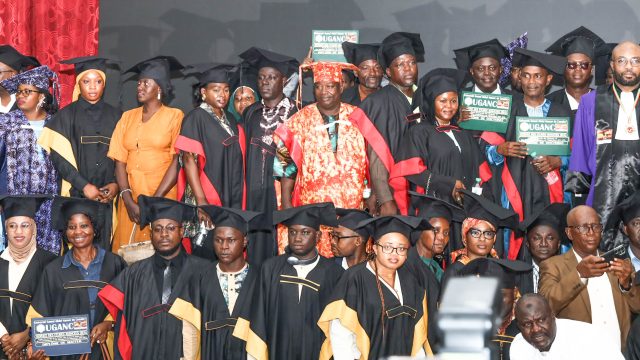
At UGANC, 206 graduates called to transform their research into solutions for Guinea
The Gamal Abdel Nasser University of Conakry (UGANC) celebrated, this Saturday, September 26, 2026, the awarding of Master’s and…
 FactuSciencesEducation
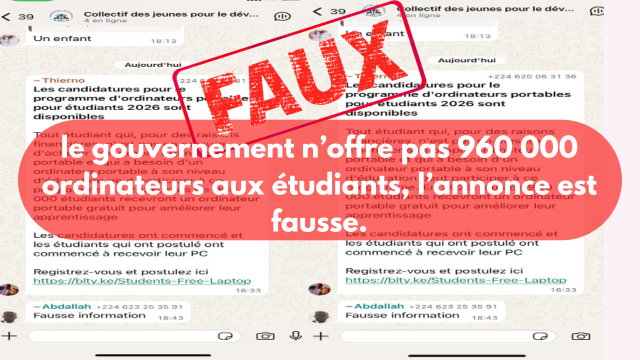
Guinea: no, the government is not offering 960,000 computers to students, the announcement is false
A message circulating widely on WhatsApp claims that Guinea will distribute more than 960,000 free laptops to its…
 UncategorizedEducationFactuSciences
No, this video of Minister Bintou Keïta promoting a guide for high school graduates is not authentic
A video showing the Minister of National Education, Bintou Keïta, presenting a guide intended to prepare high school graduates for university has been circulating for...
Leave a Reply