

Kush in Guinea: understanding trafficking involving defense and security forces

Illustration of security force agent corruption facts © Image Generated by AI
In Guinea, as in several countries in the West African sub-region, the consumption of the drug called Kush has become a daily reality, mainly affecting young people. While numerous studies have highlighted the deleterious impact of this substance on the health of young people, a less visible but equally alarming phenomenon has developed: the involvement of certain actors from the defense and security forces in the trafficking of this drug. Through this investigation, we reveal how Kush enters Guinea, trafficking involving defense and security forces.
Friday April 11, 2025, around 6 a.m., a 4×4 car registered IT-0743-B, coming from Forécariah, overturned in Manéah, in the prefecture of Coyah. Inside, there were drugs, but the driver and a passenger fled after the accident. Images circulating on social media clearly show the presence of drugs in the vehicle. However, throughout the night, control brigades were deployed on the roads.
Controls and complicity of defense and security forces
To try to unravel the mystery surrounding the control carried out at roadblocks in the interior of the country, we carried out an investigation by observing the operation of several roadblocks, by moving our camera to understand how drugs circulate.
At 4 a.m., our vehicle parks in front of the first dam at Coyah. An intriguing scene unfolded: a surprising discussion began between a police officer and our driver. In the end, the police officer lets our vehicle pass without control, in exchange for a simple request for documents.
“I ask for the documents, you say you are going to such and such a place. Those are Guineans, go ahead." the policeman tells us, before ordering: « Free! » .
Further on, when we passed the second roadblock, our driver insisted with the policeman to have the vehicle checked, which was not even equipped with license plates on the front. “No, it’s a car. If it doesn't have plaque, you need to check. We must not say that there is this and that. expressly states the driver.
At four roadblocks crossed that night, no identity checks or rigorous baggage searches were carried out.
Deep involvement of defense and security forces
The testimonies collected confirm a worrying involvement of certain agents in the proliferation of the drug Kush in Guinea. At the end of the negotiations, a security agent, contacted anonymously by telephone, told us: “Drugs cross the border between Guinea and Sierra Leone each time. Sometimes when there are seizures, we never know what happens to them. Customs is supposed to handle this.”
This consumer that we will call Julien, met in a suburb of Conakry, goes further by denouncing the defense and security forces, who should prevent the entry of Kush into Guinea, but who let it happen, probably for the money. Some of them even sell drugs to young people. In some places, it is even soldiers who sell Kush.
“In principle, defense and security forces must do their job. They must not allow Kush to enter Guinea. But why do they allow this drug to come in? If it's not for money? They are influenced by money and they cannot accomplish their mission,” he accuses before adding:
“They are the ones who bring in the drugs, they sell them to young people and when we tell them to catch the bandits, they go and catch the same young people. In some temples even, it is soldiers who sell Kush.”
To try to understand the involvement of defense and security forces in the proliferation of this drug in Guinea, we went to this roadside “temple”. There, Kush consumption is in full swing. It's 1 a.m. this Saturday. It's our lucky day. We clearly see an individual dressed in military attire holding a bag of Kush.
The director of the institute responsible for the fight against drugs also highlights other entry points for this drug: “Especially the landing stages facing Sierra Leone. It passes through our border crossings. Unfortunately, we have borders that are porous. This now allows the penetration of drugs, particularly Kush.”
Young people in great distress facing addiction
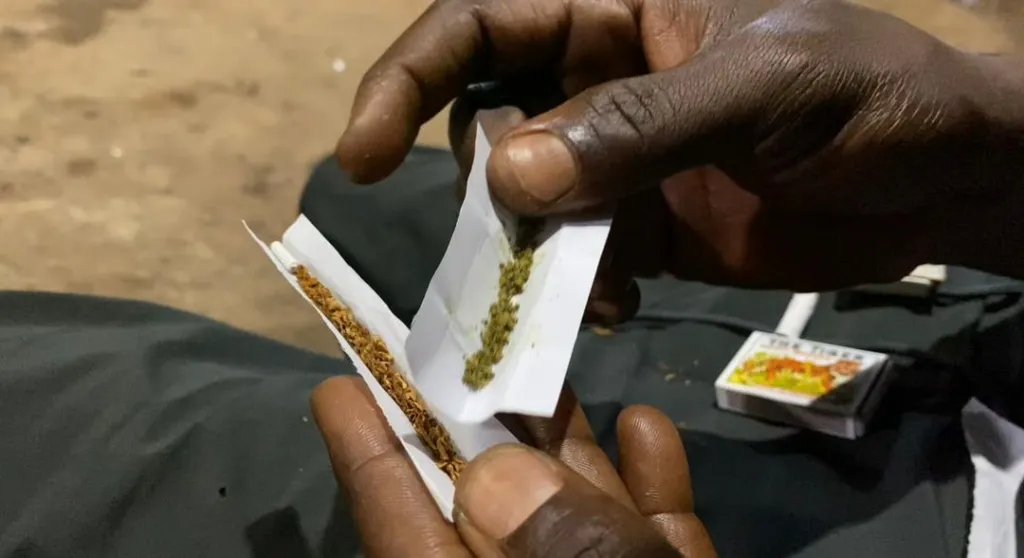
In our field observation, we met dozens of young people for whom Kush is now omnipresent in their lives. They indulge in it daily, some spending their nights in places along the roads, where they consume joints repeatedly. The sale of this drug is around 10,000 GNF per dose. The addiction is such that the withdrawal causes physical and psychological pain according to these consumers. For them, it is impossible to go long without smoking.
“It’s a bad thing. When you don't consume it, you won't be comfortable. You will see that your bones hurt, you have body pains. Sometimes even your tears flow", Julien testifies. His friend adds: “It’s not a drug, it’s a virus. When you wake up in the morning, you don’t need anything except this drug.”
Kush, a public health problem
According to the Traveling Institute for Integrated Training and Prevention against Drugs and Other Addictive Behaviors (IIFPIDCA), between 2023 and 2024, 53 people died in Guinea because of this addiction. Present in all regions of the country, Kush has become a major public health problem, especially among young people.
“Today, the drug Kush is a national concern. And it’s a deadly drug,” declares Thierno Barry, general director of IIFPIDCA.
Composed of cannabis mixed with chemicals such as acetone, as well as nitazenes, highly addictive and dangerous synthetic opioids, Kush causes serious effects, ranging from agitation to death. “When you consume the drug Kush, already on the physical level, the person is agitated, there is profuse sweat on their body and above all the person swallows their tongue,” explains Dr. Barry. Faced with this proliferation, a crucial question arises: who is behind the circulation of this drug in Guinea?
Kush entry routes into Guinea
Traffickers mainly use two routes to bring in Kush: sea and land. Drugs are hidden in luggage, sometimes even in vehicle tires. Sierra Leone, a border country often considered a nerve center for this drug in West Africa, plays a central role in this circulation. A regular driver on the Forécariah route explains his stratagems to smuggle drugs from this border country.
“If we go to Sierra Leone, they smuggle the drugs in the canoes. Afterwards, we stay in contact with the person who is to receive it in Conakry. Now I put the drugs in my spare tire, it will be hard to find them,” he says. Julien testifies to having seen cargoes of Kush unload at the artisanal port of Boulbinet, located a few meters from the Mohamed V palace, residence of the president of the transition.
“I saw canoes unloading this drug in Boulbinet. And I also saw a car coming to deliver my grandfather's goods. Yes, I saw that. The drugs enter by sea and land,” he says.
Kush trafficking in Guinea reveals well-organized clandestine networks, sometimes with the complicity of certain agents of the defense and security forces, and at the highest level of the institutions supposed to ensure the country's security. While young people fall into addiction, these networks ensure the distribution of this deadly drug, fueling a vicious circle that threatens the stability and public health of the country.
Mansa Moussa Mara
Read also
 HealthDisease
16 chemotherapy sessions: M’balia Batchily recounts her fight against breast cancer
A simple gesture, a mass discovered in time, sixteen chemotherapy sessions. Guest of the show Les Impertinents, on La Guinée Fréquence, M’balia…
 HealthDisease
Deafness in Guinea: when social perception complicates monitoring
On the occasion of World Deaf Day, celebrated each year on the last Sunday of September, deafness returns to…
 FactuSciencesMedicineHealth
Apple cider vinegar, cinnamon, green tea and cloves do not “kill” sugar in the body of diabetics
This 2 minute 36 second video (archived link here) in which the author claims to share tips that “can kill” sugar in…
Leave a Reply