

Kassa, the island where plastic hunts marine life

Waste litters the beaches of Kassa Island, Nov. 2025 © @LeBagou / UniverSciences
In the Loos Islands archipelago, on the island of Kassa, about 7 km from Conakry, fishing, the main activity for the approximately 20,000 inhabitants, is declining sharply due to plastic pollution. Waste accumulates along the beaches and in the town's artisanal ports, threatening fisheries resources.
According to a report from FEGEDEG (Guinean Federation of Waste Managers) dating from 2018, Conakry generates more than 1,000 tonnes of waste per day, of which approximately 20% plastics. This pollution now extends to Kassa, in particular because part of the capital's plastic waste is carried by high tide to the island.
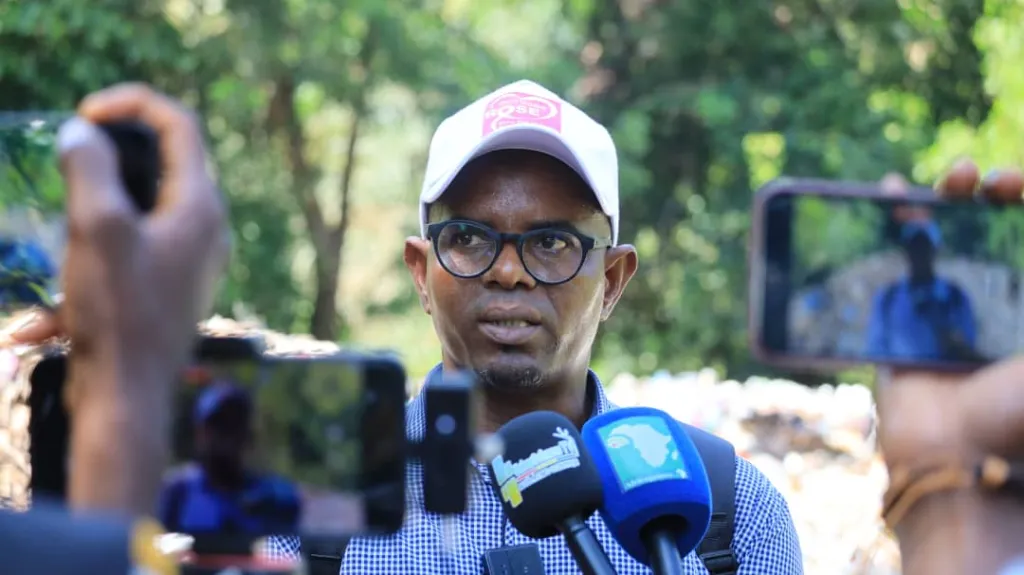
“Most of the plastic waste comes from Conakry, once there is high tide, a lot of garbage leaves the capital and ends up here,” explains Lamine Bangoura, deputy port manager in Koromandja.
Fish are becoming rare
Once prosperous, fishing in this area is now threatened: plastics deposited on the seabed disrupt ecosystems, pushing fish towards more favorable areas. “When dirt settles in the mud it reduces fishing. If the fish finds waste in this area, it will flee,” testifies Lamine Bangoura. According to him, the hauled nets are often filled with waste, with very few fish.
Experts warn of the health consequences: plastic, particularly in the form of microparticles, can cause the disappearance of certain species and contaminate the food chain. Dr Baldé Mamadou Yaya, environmental chemist, indicates that "certain fish absorb these particles which can be carcinogens».
Challenge in waste management
In Kassa, waste management remains a major challenge: a sorting center was built at the beginning of 2024, but is still not operational due to lack of personnel and equipment, according to Alseny Camara, administrative secretary of the municipality. For the moment, the only solution for residents is the incineration of garbage: “We choose a day, we collect the garbage and we burn it. This is our solution and we do it regularly,” admits Mr. Camara.
However, incineration worsens pollution according to specialists: “It should not be an alternative for rational waste management. On the contrary, we must prioritize recycling”, recommends Dr Baldé Yaya.
The community calls for help
Faced with degradation, Mohamed Lamine Cissé, neighborhood chief, calls on the State to support the local cooperative of women responsible for sweeping. “We don’t have the means. The state must help us”, he insists.
The projections of theOrganization for Economic Co-operation and Development (OECD) are alarming: without more ambitious measures, the quantity of plastic waste produced globally could almost triple by 2060. According to the OECD, the share of plastic waste that is actually recycled is expected to be 17% of the total in 2060, up from 9% in 2019, while incineration and landfilling will continue to account for around 20% and 50% of plastic waste, respectively. The share of plastics that escape waste management systems – ending up in uncontrolled landfills, being burned openly or seeping into soil and aquatic environments – is expected to fall from 22% to 15%.
Article written by Mansa Moussa Mara as part of the Afrikibaaru 2 Project implemented by CFI with funding from AFD
Read also
 Environment
Seizure of 41 kg of seahorses and 26 kg of shark fins, the underside of trafficking that threatens marine biodiversity
At the end of May 2026, the NGO Eagle Guinea, in collaboration with the Guinean special services, carried out a major seizure,…
 Environment
Malé Camara, doctoral student, highlights the still under-exploited potential of the Upper Senegal River basin
A study which focuses on the identification of optimal sites for the establishment of micro-hydroelectric power stations in the Futa-Djallon basin. Its objective to contribute…
 Environment
Guinea/Lola: the last chimpanzees of Bossou disappear in silence
The survival of Bossou’s chimpanzees now depends on just three individuals. We are in Bossou, a sub-prefecture located more than 1000 kilometers away…
Leave a Reply