

Sickle cell anemia and hemophilia: Guinea prepares its national treatment guide
 By Alpha Oumar Bagou Barry ·
· 7 views
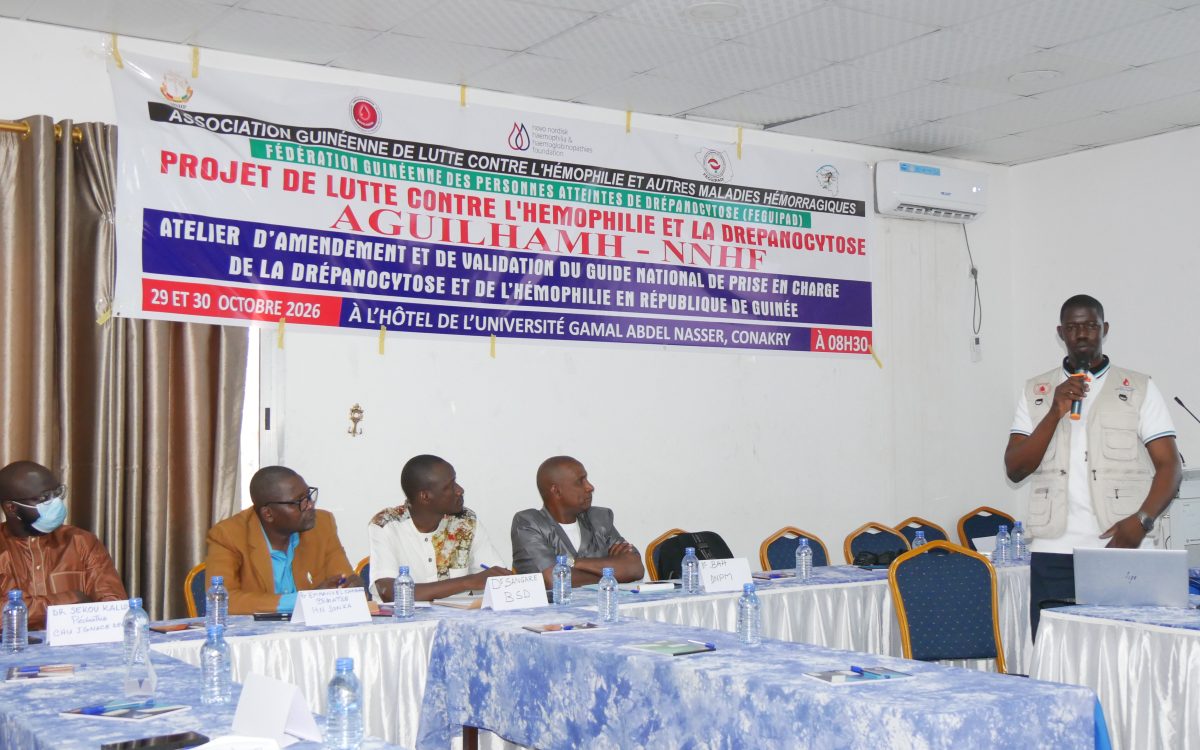
Overview at the validation workshop, Conakry 10/29/26 © Bagou BARRY
In Guinea, around 5,000 children are born each year with a serious form of sickle cell anemia according to the hematology department of the Ignace Deen and Donka University Hospitals. So that each patient, sickle cell or hemophiliac, is treated in the same way wherever they live, a national workshop is bringing together in Conakry from October 29 to 30, 2026, around forty specialists around a draft guide.
Two days to agree on best practices
In Conakry, health professionals, institutional managers and representatives of patient associations meet, for two days, around the same document: the draft national guide for the management of sickle cell anemia and hemophilia. Coming from the country's health structures, the forty participants must examine it, amend it and achieve consensual validation, before its transmission to the competent authorities. The workshop is organized by the hematology departments of the Ignace Deen and Donka University Hospitals. Its objective: to provide Guinea with a validated guide applicable to all levels of care.
But what are these diseases?
The sickle cell anemia is a serious inherited blood disorder caused by a mutation in the HBB gene, leading to the production of abnormal, sickle-shaped red blood cells that block blood flow and cause serious complications. In 2021, the WHO estimated 7.74 million people with sickle cell disease worldwide, including 515,000 newborns, primarily in sub-Saharan Africa, a region that accounts for nearly 80% of cases globally.
L’hemophilia is a serious hereditary genetic disease, which results in difficulty for the blood to clot normally. Coagulation is a complex process that involves numerous proteins called coagulation factors.
According to an article published on Inserm, the consequences are major, with severe bleeding in the event of injury and spontaneous bleeding in certain patients, particularly in the joints. However, thanks to increasingly innovative treatments, including gene therapies, the disease is now well controlled in most cases. Research is continuing to further improve the effectiveness and duration of action of these treatments.
An observation: care that varies from one place to another
Sickle cell disease constitutes a major public health issue in Guinea. According to estimates reported in the terms of reference of the workshop, approximately 5,000 children with major sickle cell syndrome are born each year in the country. Hemophilia, for its part, poses challenges in terms of diagnosis, treatment and monitoring.
A situation analysis carried out in May 2026 noted three weak points: concentrated care provision, limited diagnostic capacities and the absence of national guidelines. The future guide must help harmonize practices and clarify who does what, at different levels of the health system.
A tool for all stakeholders
For Professor Ag. Mamady Dikité, head of the hematology department at Ignace Deen University Hospital and coordinator of the development of the guide, the document first provides an update of knowledge, supplemented by practical sheets: “Firstly it updates us on the different diseases, what they represent in the world currently. So there is an update in the form of generality. But beyond that there are practical sheets relating to the different specificities, because the disease has its representations, the complications also have their presentations and in each of these dimensions there is a behavior. This behavior is well developed and will be applied by all stakeholders. This can facilitate decentralization and facilitate communication between actors wherever they are. »
For Dr. Mama Doufary Diallo, of SOS Drépano Guinée, the issue is that of equality in care, because patients live everywhere in the country: “Standardize our practices, and especially because children and people with sickle cell disease and hemophilia are spread across all countries. It is therefore to give equal opportunity to the care of all patients. »
On the patient side, Abdoulaye Camara, president of the Guinean Association for the Fight against Hemophilia and Other Hemorrhagic Diseases (AGUILHAMH), is delighted with this initiative and sees it as a tool for clarity for healthcare teams:
“It’s a very strategic document. Who will help patients, but also nursing staff in the management of these diseases. This will help determine each person’s role. From a nurse, a biologist, a doctor. To avoid trial and error in handling. »
Once amended and validated by the participants, the guide will be sent to the competent authorities. The stated ambition is for it to serve as a common reference, from the health center to the hospital, so that each child with sickle cell disease and each hemophilia patient benefits from quality care, everywhere in Guinea.
Read also
 HealthDisease
16 chemotherapy sessions: M’balia Batchily recounts her fight against breast cancer
A simple gesture, a mass discovered in time, sixteen chemotherapy sessions. Guest of the show Les Impertinents, on La Guinée Fréquence, M’balia…
 HealthDisease
Deafness in Guinea: when social perception complicates monitoring
On the occasion of World Deaf Day, celebrated each year on the last Sunday of September, deafness returns to…
 FactuSciencesMedicineHealth
Apple cider vinegar, cinnamon, green tea and cloves do not “kill” sugar in the body of diabetics
This 2 minute 36 second video (archived link here) in which the author claims to share tips that “can kill” sugar in…