

Apple cider vinegar, cinnamon, green tea and cloves do not “kill” sugar in the body of diabetics
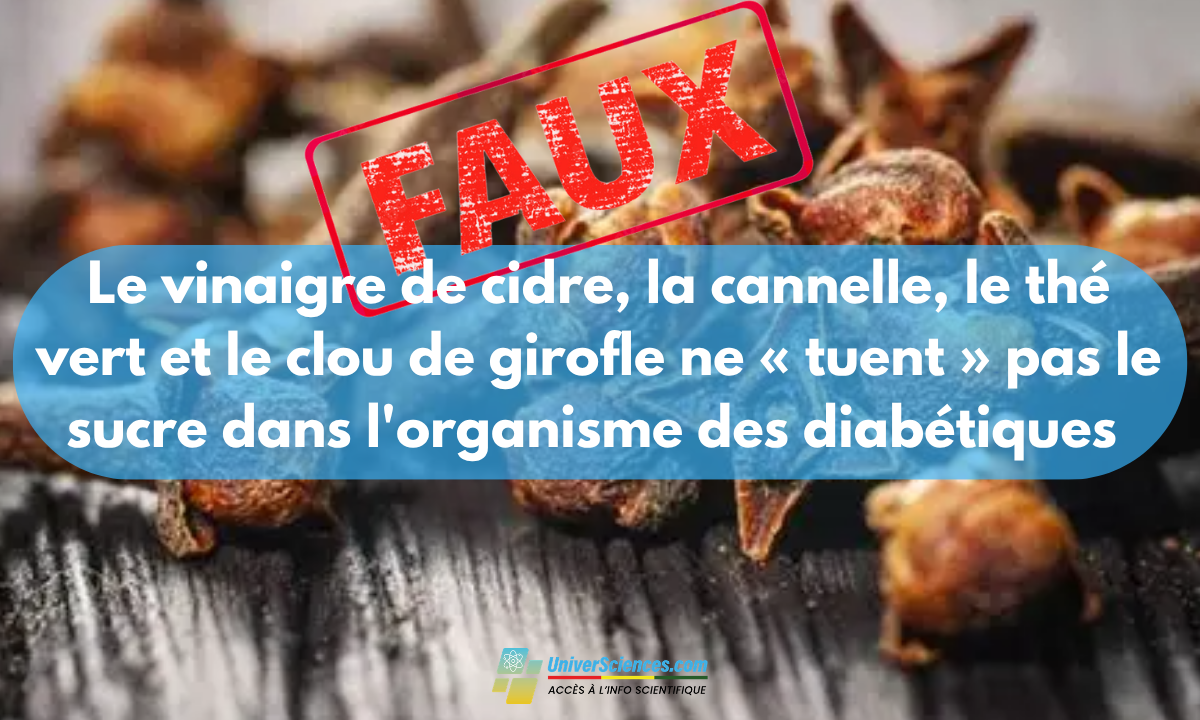
Visual integrating the verdict after the verification work © Bagou BARRY
This 2 minute 36 second video (link archived here) in which the author claims to share tips that “can kill” sugar in the body of diabetics is false. Published in November 2025 on the social network Facebook by Barry Pellal Media with the description “Tips that kills sugar in your body », the video had, at the time of publication of this article, several million views, more than 33,000 shares and more than 1,500 comments.
In the video, the author claims that four natural remedies can “ kill sugar » in the body of people with diabetes: apple cider vinegar diluted in water, cinnamon tea, green tea, and clove juice or powder. The video explicitly targets people with diabetes, prediabetes or high sugar consumers, presenting these remedies as immediately effective.

First, we identified and isolated each statement. The video presents four distinct remedies as capable of “ kill sugar » in the body. Each claim has been verified separately, comparing the claims to the scientific evidence on each ingredient. For each ingredient, we searched for clinical studies and meta-analyses published in journals, including Diabetes Care, Journal of the Endocrine Society and Journal of Natural Medicine, LaNutrition.fr and also Medisite.fr, as well as the French Federation of Diabetics.
We sought the advice of a specialist. Dr Amadou Bah, head of the diabetology department at Donka University Hospital, was contacted to contextualize the scientific data in Guinean medical reality and assess the concrete risks for patients. Finally, for more details, we went to meet Dr Tanou Valdez Bah, pharmacist and specialist in natural product sciences and researcher at the Institute for Research and Development of Medicinal and Food Plants of Guinea (IRDPMAG).
Apple cider vinegar: PARTLY TRUE
Apple cider vinegar does not eliminate diabetes, but it can lower blood sugar levels. It does not replace medications, but it can complement the treatment of diabetes, according to Nutrition.
Dr Amadou Bah specifies that « many plants and barks have an immediate hypoglycemic power, but not in the long term, while diabetes medications all have a scientifically established action time and elimination time.. » The expression “ kill sugar » is false and misleading: vinegar regulates blood sugar, it does not eliminate it.
This is also the opinion of Dr Tanou Valdez Bah. For him, the species cited by this traditional practitioner have shown, in the scientific literature, a potential for reducing blood sugar levels, « I wouldn't say kill diabetes », he nuances. But these are tests that remain at the laboratory level, much more in vitro tests, not even on mice, he continues. « So, we cannot say that these are remedies that necessarily treat diabetes, but which can have anti-diabetic potential because we have to make the difference. », explains the specialist in medicinal and food plants.
Cinnamon Tea: PARTLY TRUE
Meta-analyses relayed by E-Santé.fr published between 2024 and 2025 report a significant decrease in fasting blood glucose in type 2 diabetic patients and prediabetics, with an average reduction of approximately 15 mg/dL. The most recent meta-analysis (2025), which brings together 28 randomized trials and 3,054 type 2 diabetic patients, figures this reduction at 15.26 mg/dL on an empty stomach and 39.22 mg/dL after meals, for doses less than or equal to 2 g per day.
These effects are not immediate, however, because continuous supplementation over a period of 8 to 12 weeks is often necessary to observe significant biological changes, the researchers agree. According to E-Health, cinnamon is in no way a substitute for prescribed medicinal treatments. Affirm that this “ completely kills » sugar is scientifically inaccurate and exaggerated.
Dr Valdez Well, he raises questions that remain unanswered in the video. For him, it is necessary to know what type of cinnamon it is, because there are two types of cinnamon.
« There is cassia type cinnamon and there is Ceylon type cinnamon… And in addition to the plants he mentions, what part of the plant is active? What type of preparation does he do? What is the dosage he gives? », asks the specialist in medicinal and food plants. Almost all clinical trials on blood sugar levels focus on Cassia cinnamon. But this contains up to 250 times more coumarin than Ceylon cinnamon, a molecule toxic to the liver at high and repeated doses. Consuming Cassia cinnamon daily to “lower sugar” is therefore not without risk.
Green tea: REAL WITH NUANCES
Epigallocatechin 3 gallate (EGCG), a component of green tea, may play an important role in reducing blood sugar spikes. Consumed at the same time as foods rich in starch, this molecule reduces the blood sugar peak that occurs after the meal, with a reduction of up to 50% with corn starch, according to the French Federation of Diabetics. This 50% reduction must, however, be put into perspective. It was measured in mice, in a study published in 2012, and not in humans. The authors estimate the tested dose to be the equivalent of approximately one and a half cups of green tea. In people who do not suffer from diabetes, green tea does not cause hypoglycemia: it lowers blood sugar levels only in diabetics, specifies. Creapharma. This is the most reasonable assertion in the video, but it remains incomplete due to the lack of specifying the doses and limits of this effect.
Clove: PARTLY TRUE
Researchers examined the effect of 250 milligrams of polyphenol-rich clove extract on adults with prediabetes. “ For 30 days, participants took a clove supplement after meals. The prediabetic group recorded glucose levels 27% lower than baseline. Researchers concluded that a polyphenol-rich clove extract may help maintain healthy glucose metabolism, especially in people with prediabetes. », reports My Natural Health. Theoriginal study, published in 2019 in BMC Complementary Medicine and Therapies, is an open pilot trial carried out on only 13 volunteers, including 6 prediabetics. Its results are preliminary and do not allow any generalization.
According to Dr Valdez Bah, we cannot even speak of effectiveness on a human scale for the moment, because these are plants, in the literature, which have been tested in the laboratory. « But you should know that a plant can be effective because it contains metabolites which can be different from one area to another” he added.
Nearly 589 million adults were living with diabetes in 2024
According to the International Diabetes Federation, nearly 589 million adults were living with the disease in 2024, or 11.1% of the global population aged 20 to 79. Type 2 diabetes alone represents 92% of cases, and its prevalence has doubled in thirty years. These data come from the 11th edition of the IDF Diabetes Atlas, published in 2025, which projects 853 million adults with diabetes in 2050 and estimates the number of patients who are unaware of it at 252 million.
In sub-Saharan Africa, the situation is particularly worrying. According to data published on ScienceDirect, the number of people with diabetes is expected to almost triple between 2017 and 2045, from 16 to 41 million.
In Guinea, the trend follows the same trajectory. According to the head of the diabetology department at Donka University Hospital, around 5% of the Guinean population is diabetic, with a constant progression affecting all social strata. This rate, taken from the national STEPS survey, had already been publicly advanced by the same specialist in March 2025.
Dr Amadou Bah is categorical: “ Today, we cannot cure this metabolic disease linked to a defect in the production of insulin by the pancreas. He also deplores the « absurd communications on social networks about diabetes, without control, which have a negative impact on the care of diabetic patients ».
For Dr Tanou Valdez Bah, we are talking more about diabetes management, we are not talking about diabetes treatment. « To go so far as to say that these plants kill diabetes is perhaps saying too much, because we do not know how we kill diabetes, it is a pathology, we cannot kill the pathology”, says the pharmacist, specialist in natural product sciences and researcher at the Institute for Research and Development of Medicinal and Food Plants of Guinea (IRDPMAG)
What is really dangerous
All sources consulted agree that advice aimed at “ kill sugar » are dangerous for diabetics. They also emphasize that severe hypoglycemia can cause coma or death, and no treatment should be changed without medical advice.
« These remedies offered by traditional practitioners should not be associated with their anti-diabetic treatment, because if it turns out that their traditional treatment is effective, there will be a double drop in blood sugar levels which can lead to severe hypoglycemia. », warns Dr. Valdez.
Dr Amadou Bah recalls that the management of diabetes is based on a suitable diet, medications or insulin and regular physical activity. Experts also highlight the lack of precise dosages and point out that these remedies do not replace insulin, especially for type 1 diabetics.
Verdict
All four ingredients listed have real scientific basis for helping regulate blood sugar levels. But the video exaggerates their effects with wording like “ kill sugar » or “ completely ”, and omits essential warnings. Presented as sufficient solutions, these remedies can lead patients to abandon their treatment, which represents a vital risk.
« We are talking more about diabetes management, we are not talking about diabetes treatment. So going so far as to say that these plants kill diabetes is perhaps saying too much, because we don't know how we kill diabetes, it's a pathology, we can't kill the pathology. It's not a bacteria, it's not a virus." concludes the specialist in medicinal and food plants.
Dr Amadou Bah confirms this unambiguously: “ Diabetes is one of chronic diseases such as hypertension, asthma and cancer. To treat it, we have scientific references from experts in the field ».
This article was written by Mamadou Kindy BAH as part of the Afri’Kibaaru 2 Project implemented by CFI, with financial support from AFD. It was edited by Carol Valade and approved by Sally Bilaly Sow.
Read also
 HealthDisease
16 chemotherapy sessions: M’balia Batchily recounts her fight against breast cancer
A simple gesture, a mass discovered in time, sixteen chemotherapy sessions. Guest of the show Les Impertinents, on La Guinée Fréquence, M’balia…
 HealthDisease
Deafness in Guinea: when social perception complicates monitoring
On the occasion of World Deaf Day, celebrated each year on the last Sunday of September, deafness returns to…
 HealthDisease
Cardiac delays in Conakry: what a Guinean study reveals
A patient has been experiencing chest pain for several weeks. He first consults a local health center, then waits…